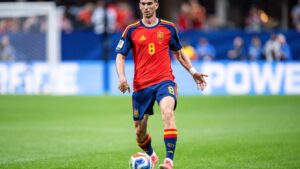
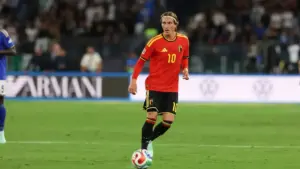
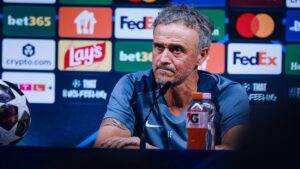
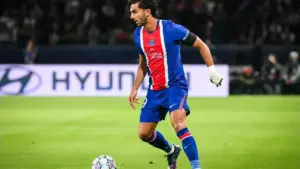
Luis Enrique has won back-to-back Champions Leagues by making Paris Saint-Germain the team that keeps the ball, and that begins in the engine room. Working out who makes up the PSG midfield in 2026/27 means working through seven names: Vitinha, João Neves, Fabián Ruiz, Warren Zaïre-Emery, Senny Mayulu, Maghnes Akliouche and Dro Fernández. Between them they cover a vice-captain, a €50m summer signing, two academy graduates and the pair widely credited with turning Paris into European champions.
It is also the part of the side under most scrutiny this month. Paris are winless in Ligue 1 after three matches — 2-2 at Rennes, 2-2 at Lille and a 2-1 defeat to Monaco — and Luis Enrique did not dress it up, telling reporters that “if we’re just talking about results, it’s been a disastrous start to the season”. With the Champions League defence starting against Yaya Touré’s Slovan Bratislava on Wednesday, here is the full picture of what Paris have in the middle.
Vitinha (No.17) — the metronome
If there is one player the whole system runs through, it is Vitinha. The Portuguese wears No.17 and is one of Marquinhos’ vice-captains alongside Achraf Hakimi and Ousmane Dembélé — a fair reflection of how central he has become to both the football and the dressing room.
His job is the least glamorous and the most important: receive under pressure, turn away from it, and keep Paris facing forward. When Vitinha plays well, Paris control games. When he does not, they look like the side that has drawn twice and lost once this month. Our full profile of Vitinha goes deeper on how he got here.
João Neves (No.87) — the engine
Neves is the other half of the partnership that carried Paris to two European Cups. He wears the unusual No.87, and he is the one who covers the ground — pressing, recovering, arriving late in the box. Where Vitinha slows a game down, Neves speeds it up.
The pair have been used together often enough that Paris supporters treat them as a single unit, and it is the combination Luis Enrique tends to return to when a match matters. More on what Neves brings to the middle.
Fabián Ruiz (No.8) — the manager’s man
Ruiz has the No.8 and, arguably, the closest understanding with the manager of anyone in the squad: the two worked together with Spain before Luis Enrique arrived at the Parc. He is the most languid of the group, a left-footer who can play deeper alongside Vitinha or further forward as the runner.
He is also the answer to a specific problem. When Paris need a midfielder who can break a low block with one pass rather than three, Ruiz is usually the one who starts. Read our profile of Fabián Ruiz.
Warren Zaïre-Emery (No.33) — the local one
Zaïre-Emery is the academy product who never seems to have been a prospect, because he has been a first-team footballer since he was a teenager. He wears No.33, he came through at the Parc, and he is the one whose ceiling nobody in the city has yet agreed on.
What is not in doubt is his usefulness. He has been used centrally, on the right of a midfield three and further back on the right when Luis Enrique has needed him there — a versatility that has kept him in the squad through two European campaigns. Here is the full story on Zaïre-Emery.
Maghnes Akliouche (No.11) — the new arrival
Akliouche is the biggest change to this department in a year. Paris paid Monaco a reported €50m for him in the summer of 2026, and he took the No.11 shirt — the most attacking number in the midfield group.
That is rather the point of him. Akliouche gives Luis Enrique a midfielder comfortable receiving in the final third rather than in front of it, which matters for a side that has found goals this season and dropped points anyway. More on why Paris went back to Monaco for Akliouche.
Senny Mayulu (No.24) and Dro Fernández (No.27) — the next ones
Mayulu has the No.24 and is the academy graduate who has already been trusted in the biggest games this squad has played. He is not a squad-filler; he is a footballer Luis Enrique brings on while a game is still alive.
Dro Fernández, No.27, is the newest name on the list and the one with the least first-team mileage. In a group this crowded, the sensible expectation for him is minutes rather than a starting place — but much the same was once said about Mayulu and Zaïre-Emery. Our profile of Mayulu is a useful guide to how Paris promote from within.
Who left, and what it changed
The 2026 summer thinned this area out as well as adding to it. Lee Kang-in left for Atlético Madrid in a €35m deal, and Renato Sanches’ contract was terminated by mutual agreement on deadline day, ending his Paris career as a free agent. Between them they took two senior options out of the building — part of why Akliouche’s arrival mattered, and why Dro Fernández is wearing the No.27 shirt rather than spending the season out on loan.
How the PSG midfield shapes up
Seven names for what is usually three shirts, with Zaïre-Emery able to cover a fourth role entirely. On paper it is the deepest midfield in France. On the pitch it has produced a UEFA Super Cup win over Aston Villa — the only victory of the season so far — a 1-0 Trophée des Champions defeat by Lens, and three Ligue 1 games without a win that leave Paris seven points behind Monaco, per Get French Football News.
The consolation is a familiar one. This is broadly the same midfield that was being picked over last autumn and still ended the season holding the European Cup for a second year running. Whether the answer this time is Vitinha and Neves as the fixed point, or something with Akliouche pushed higher, is the question the manager will spend the next few weeks answering — and it helps to understand how his shape asks the midfield to move before judging anyone on a bad month. You can also read our companion guide to the PSG centre-backs, or check the full 2026/27 squad numbers.