The Champions League league phase is where Paris Saint-Germain’s bid for a third consecutive European Cup begins, and after Thursday night’s draw at Monaco’s Grimaldi Forum, Les Parisiens finally know the eight names standing in the way. If you are still not entirely sure how the 36-team format works — what the table means, who goes straight through, and who gets dragged into a February play-off — here is the whole thing in plain English, with PSG’s own route mapped onto it.
What the Champions League league phase actually is
UEFA scrapped the old eight-group, four-team format and replaced it with a single 36-team league table. Every club sits in one standings list. There are no groups, no group winners, and no second-placed sides squeezing through on head-to-head.
Each club plays eight matches against eight different opponents — four at home, four away — spread across matchdays from September to January. Nobody plays anybody twice. The eight opponents are drawn two from each of the four seeding pots, which is why a side can end up with Barcelona and Manchester City on the same schedule and Bratislava a fortnight later.
Three points for a win, one for a draw, one table, and at the end of January everyone knows exactly where they stand.
How teams qualify out of the league phase
The table splits into three bands once the eighth matchday is done:
- 1st to 8th — through to the round of 16 automatically, with no extra tie to play and a seeded position in the bracket.
- 9th to 24th — into a two-legged knockout play-off in February, with the eight winners joining the last 16.
- 25th to 36th — eliminated from European competition entirely. There is no parachute into the Europa League any more.
That top-eight cut-off is the whole strategic point of the format. Finishing there does not just save a club two extra fixtures in the middle of February; it means arriving in the last 16 rested, and being seeded when the bracket is drawn. For a squad already carrying a Ligue 1 title defence and a FIFA Intercontinental Cup final on 16 December, those two spare match slots are worth real money.
PSG’s eight opponents in the league phase
Per the full draw reported by Get French Football News, the back-to-back holders came out of the Grimaldi Forum with this:
- At the Parc des Princes: Barcelona, AS Roma, Galatasaray, Bratislava
- Away from home: Manchester City (Etihad Stadium), Aston Villa (Villa Park), Villarreal, Como
It is not a kind draw. Two of the four away trips are to the Premier League, one of them to Enzo Maresca’s Manchester City, and the marquee home night is Luis Enrique against Barcelona — his former club, and a side who lost at home to Paris last season and will fancy settling it. Hansi Flick’s team coming to the Parc is the fixture the calendar will be built around. Our full breakdown of PSG’s Champions League opponents goes through each of the eight in more detail.
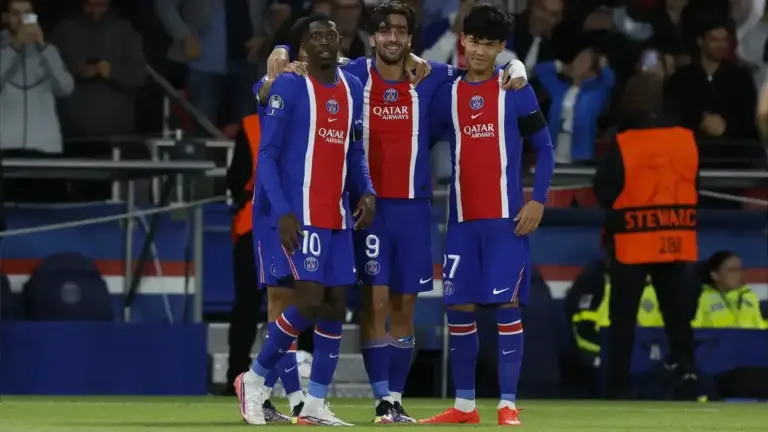
There is a subplot to the Barcelona tie beyond the manager. Ferran Torres joined Paris from Barcelona this summer for €48.5m and now wears the number 9. He will face the club that sold him under the lights at the Parc.
Why this format suits a squad built like PSG’s
Eight different opponents across five months is a broader test than six matches against three teams ever was. There is no soft group to coast through and no dead final matchday, because every side is still climbing or defending a position in one table. It rewards depth and punishes anyone treating September as a warm-up.
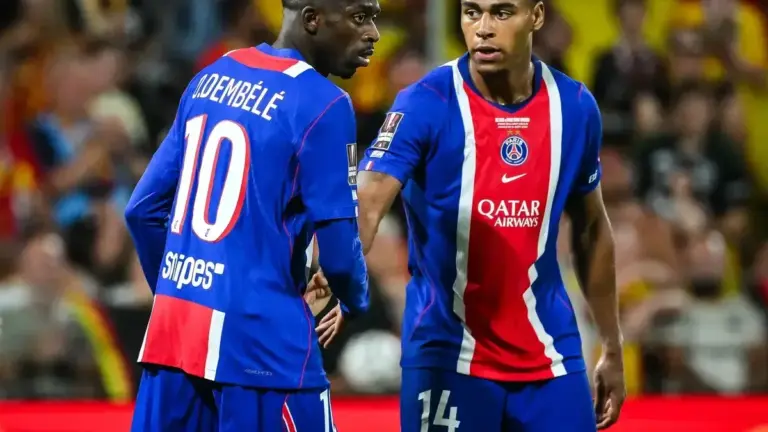
Which is roughly the argument for how Paris have been assembled. Luis Enrique has two credible options in almost every position, five summer signings still bedding in and an academy group already promoted to the senior squad — the sort of group you need when the schedule refuses to let up. Our full PSG squad guide for 2026/27 has the numbers and the new arrivals.
It also explains the rotation that has already raised eyebrows in August. Managing minutes in the opening weeks of a Ligue 1 campaign is not caution when eight European fixtures, a title defence and a December final in another hemisphere are stacked up behind it. It is arithmetic.
What a third straight European Cup would mean
Paris won the Champions League in 2024/25 and retained it in 2025/26, beating Arsenal in the final to become back-to-back holders. Going again would put them somewhere only Zinedine Zidane’s Real Madrid have been in the modern era — a genuine three-peat, achieved in an era of expanded calendars and thirty-six-team league phases specifically designed to make dominance harder.
The league phase will not win them anything on its own. It cannot; there is no trophy for topping the table. But it quietly decides the shape of everything that follows: a top-eight finish and a seeded, rested run at the knockouts, or 9th to 24th, a February play-off, and two extra games in a season that already has too many.
The Champions League league phase in one paragraph
Thirty-six teams, one table, eight games each. Top eight go straight to the last 16. Ninth to 24th play off over two legs in February. Everyone from 25th down goes home with nothing. PSG host Barcelona, Roma, Galatasaray and Bratislava, and travel to Manchester City, Aston Villa, Villarreal and Como.
Five months, eight opponents, one clear objective before the calendar turns: finish in that top eight.